TL;DR: Compositional diffusion can average incompatible local modes into an infeasible plan. MaxCD changes the sampling transition on overlaps to reduce persistent mode-averaging, without retraining or additional denoiser evaluations.
Planning success and runtime. Success rates and per-plan runtimes averaged over PointMaze-Giant-Stitch and AntMaze-Giant-Stitch. CDGS adds denoiser evaluations for resampling and candidate ranking, while ECD adds corrections to the composed plan. On these two mazes, MaxCD achieves the highest success rate among the compared methods with 7–10% more planning time than CompDiffuser and no additional denoiser evaluations.
When local plan distributions are multimodal, neighboring local plans may be denoised toward incompatible modes.
A local plan conditioned on these neighbors through its overlaps can then have a denoised estimate between the modes,
in a low-density region. The composed plan can therefore be infeasible even when each mode represents feasible local behavior.
In the circular-arc example, the local diffusion model is trained on short segments along the circle, and three
overlapping local plans are composed to connect the start
and goal
.
A trajectory is valid when all its states and segment midpoints lie within the shaded ring,
so feasible plans follow either the upper or the lower half of the circle. Invalid plans are drawn in red.
CompDiffuser often generates trajectories through the interior of the circle, where they depart from the
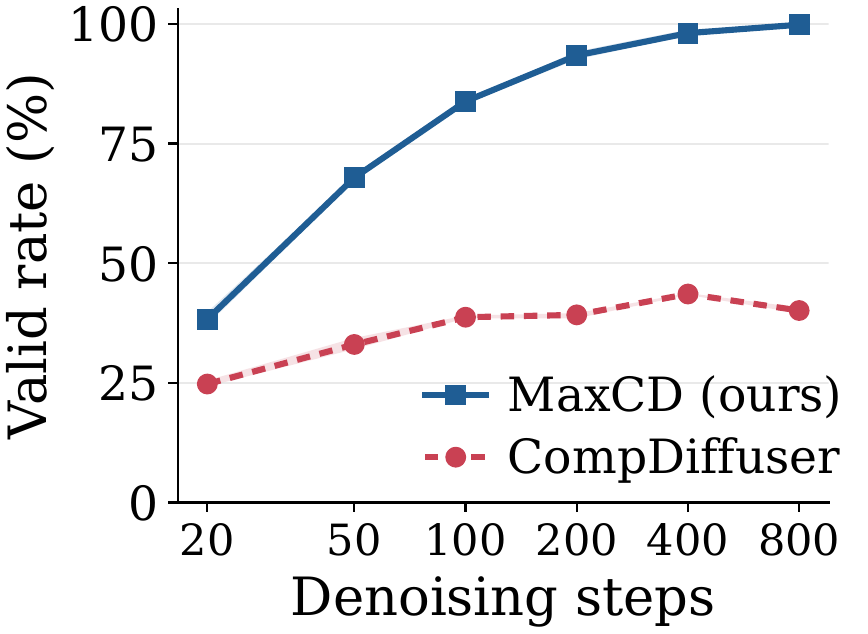
regions supported by the training data, and increasing the number of denoising steps does not reliably resolve this.
Using the same trained model and composition rule, MaxCD produces more valid plans along the circle.
Training segments. Short segments, each represented by three positions along a 60° arc.
Valid rate vs. denoising steps. With more denoising steps, the valid rate improves substantially for MaxCD but remains low for CompDiffuser.
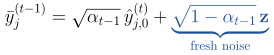
Let yj(t) denote local plan j at denoising step t. The sampling transition combines the denoised estimate, the noise direction predicted from the current state, and fresh Gaussian noise:

Scroll equations horizontally to read all terms.
The predicted noise direction is computed from the current noisy state and reused to construct the next state. Substituting the definition of the denoised estimate makes this dependence explicit:

where

.
For a fixed denoised estimate, the retained state component ctyj(t)
carries part of the current noisy state into the next state, even when fresh Gaussian noise is added.
Increasing the noise standard deviation σt reduces ct.
At the maximal admissible value,
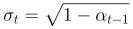
,
the coefficient becomes zero. The denoised estimate still depends on the current plan and its neighbors.
In the local model analyzed in Proposition 1, the denoised estimate stays at the midpoint between two incompatible modes
while an overlap coordinate is in the mode-averaged region. Maximal-noise transitions minimize the probability of remaining
in this region throughout a fixed sequence of denoising steps. Retaining the predicted noise direction increases this
probability under the same model.
Motivated by this analysis, Maximal-Noise Compositional Diffusion (MaxCD) applies
maximal-noise transitions to the overlaps of local plans. Setting
removes the predicted noise direction and gives the full-band maximal-noise candidate:
Scroll the equation horizontally to read all terms.
Here z is standard Gaussian noise sampled independently at each transition. Subsequent denoising conditioned on neighboring local plans can move the overlap estimate away from a mode-averaged state toward a supported mode.
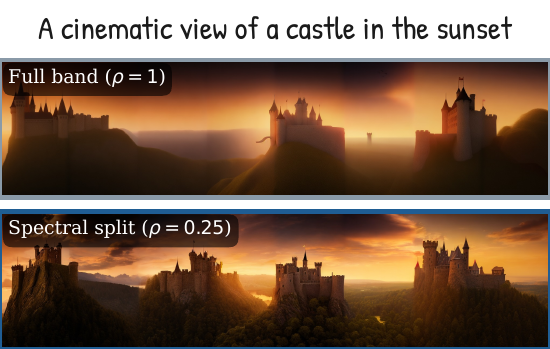
The denoised estimate used in the maximal-noise transition approximates a posterior mean, in which uncertain fine details can be averaged out. Repeatedly applying this transition across all frequency components can therefore suppress fine details. To preserve them, a spectral split applies maximal-noise transitions to low-frequency components, which can revise coarse trajectory geometry, and retains the original transition for high-frequency components. The split is taken along the local-plan horizon in planning and along the spatial dimensions in panorama generation.
Effect of the spectral split. Same prompt and seed. Top: full-band maximal noise over-smooths the image. Bottom: the spectral split preserves fine details.
Neighboring local plans exchange information through their overlaps. We apply the candidate with the spectral split to the overlap coordinates of interior local plans and retain the original transition elsewhere. The start- and goal-conditioned plans keep the original transition throughout. The update is used only while t/T > γ, reserving the low-noise stages for refinement with the original transition. Both candidates reuse the same denoised estimate and noise prediction, so MaxCD requires no retraining or additional denoiser evaluations. The main OGBench success-rate and panorama experiments use a common noise-level threshold γ = 0.2 and spectral bandwidth ρ = 0.25, without tuning these hyperparameters separately for each task.
Overview of MaxCD, compared with CompDiffuser and CDGS. Top: CompDiffuser applies the original transition at each denoising step. Middle: CDGS performs U resampling iterations before evaluating and repopulating candidate plans. Bottom: MaxCD replaces the predicted noise direction with fresh Gaussian noise in the low-frequency components, while retaining the original transition for high-frequency components. The update applies to overlap coordinates (cyan) only when t/T > γ, with the original transition retained elsewhere and during final refinement.
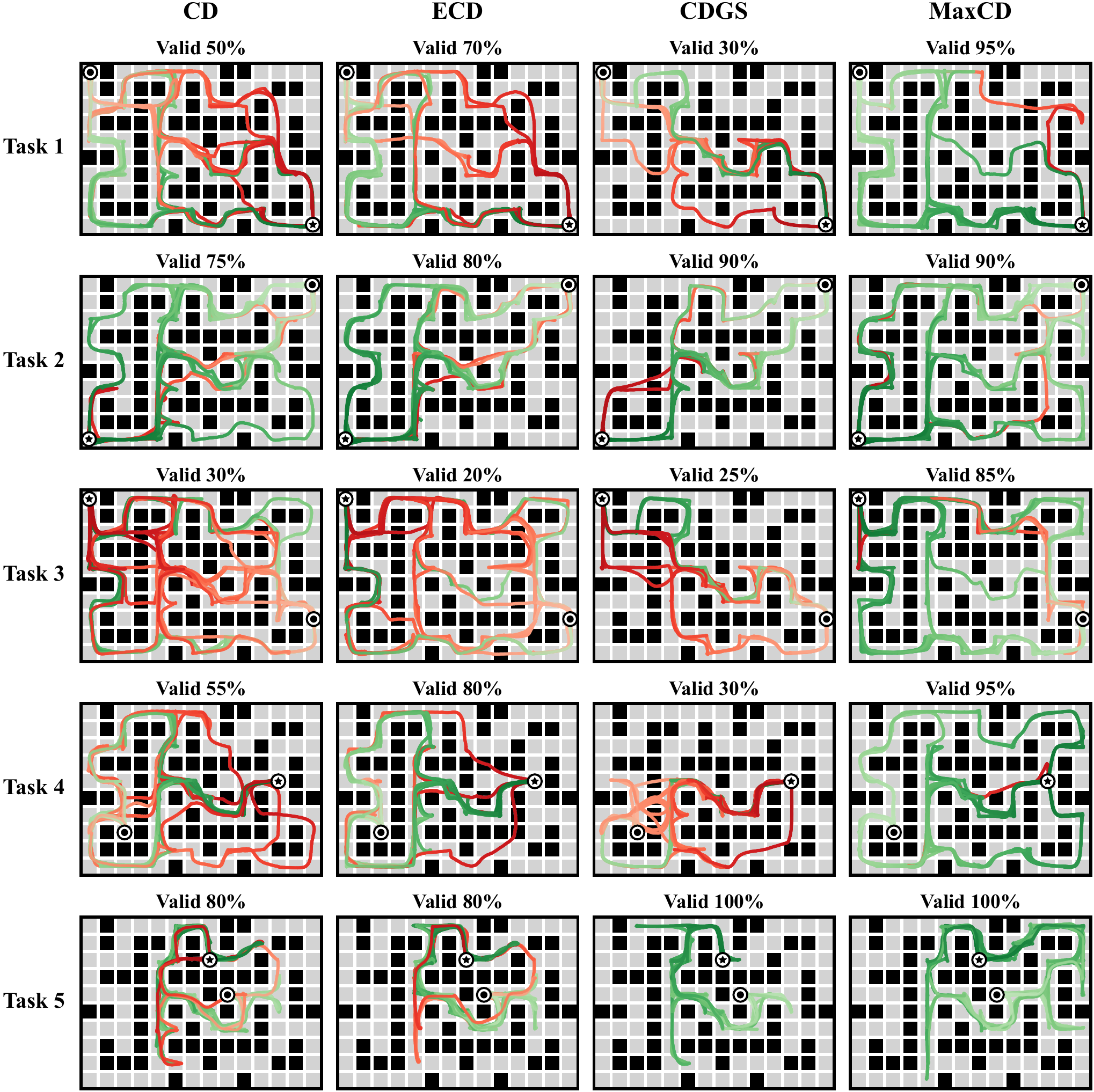
We sample 20 plans for each of the five test-time tasks in AntMaze-Giant-Stitch and measure the valid plan rate, the fraction of plans that do not pass through maze walls, for CompDiffuser (CD), ECD, CDGS and MaxCD with the same pretrained local model and start and goal conditions. CompDiffuser produces many infeasible plans that pass through walls, while MaxCD generates more valid plans that follow the corridors. In the paper's AntMaze comparison, MaxCD raises the mean valid plan rate from 36% to 86% across the five tasks. The appendix provides the same comparison on PointMaze-Giant-Stitch.
Plan feasibility on the maze selected above. Rows are Tasks 1–5 and columns are CD, ECD, CDGS and
MaxCD. Each panel shows 20 plans from the start
to the goal
;
plans crossing walls are red, valid plans are green,
and the percentages are the valid plan rates.
These videos show MaxCD plans executed in the five evaluation tasks of each environment. PointMaze, AntMaze and HumanoidMaze use plans in the 2D x–y position space, executed with a PD controller for PointMaze and learned inverse dynamics models for AntMaze and HumanoidMaze. AntSoccer uses a 17D planner that includes the ant and ball positions and the joint positions of the ant, together with an inverse dynamics model. Cube uses full-state plans executed by goal-conditioned Diffusion Q-Learning policies. Blue, pink and yellow markers indicate the start, goal and current planned subgoal. In Cube, translucent cubes show the goal configuration and dotted traces show the executed cube positions. Failed episodes are labeled when the recorded rollout set contains no successful episode for that task.
The same transition applies to image composition. We generate 512 × 4608 panoramas by composing 17 overlapping 512 × 512 windows of Stable Diffusion 2.0 with 50% overlap. MaxCD is applied to GSC using the spatial-frequency spectral split on the shared panorama latent. In the paper's evaluation, MaxCD improves visual consistency and prompt alignment over GSC with nearly the same generation time. Select a prompt to view an example generated by MaxCD.
MaxCD
GSC and MaxCD generate the selected prompt from the same initial noise over 50 denoising steps. Each frame shows the decoded noisy panorama latent at that step.
GSC (original transition)
MaxCD (with the spectral split)
MaxCD addresses persistent mode-averaging by changing the sampling transition on overlaps. The spectral split preserves the original transition on high-frequency components, with no retraining or additional denoiser evaluations. Experiments show improved plan feasibility and higher success rates on challenging locomotion and object manipulation tasks, with substantial gains on the Giant mazes. The same transition improves visual consistency and prompt alignment in panorama generation with nearly the same generation time as the base sampler.